
Uncertainty brings dispersion, not momentum
War/oil, riots, inflation, sovereign credit concerns and data centre capex
The combination of factors, which seems to get ever more complex is moving money away from the old popular trades. There is no new clear theme to guide a portfolio. Instead, investors are looking for alternatives to the AI theme and trying to derisk. This gives a very unclear direction to markets. This is a market more suited to stock picking and pair trading, not momentum investing. I advised against a Momentum strategy in October (I took my own advice!). Our September portfolio would have lost you nearly 10%!
This might seem counterintuitive in a month where the NASDAQ and S&P500 reached new highs on the 6th
But if we look under the bonnet, we see the index subsequently dominated by the Mag7 whose performance has diverged dramatically: Meta down 17% on Capex worries, Tesla up nearly 12%. If we look more broadly, we see the Russell 2000 down nearly 6% over five weeks as interest rate concerns hit smaller stocks.
Outside the US, the Japanese yen has recovered, but in Korea, the KOSP index has fallen as investors worry about the AI buildout. The anxiety about the AI buildout is in the market: Elice, A Korean data centre builder saw its share price fall 32% on opening! Data centre operators CoreWeave and Nebius have both had a torrid month. Anthropic has announced its IPO, if at a $500bn lower valuation than first suggested.
US earnings growth is very concentrated in a small number of AI linked stocks now:
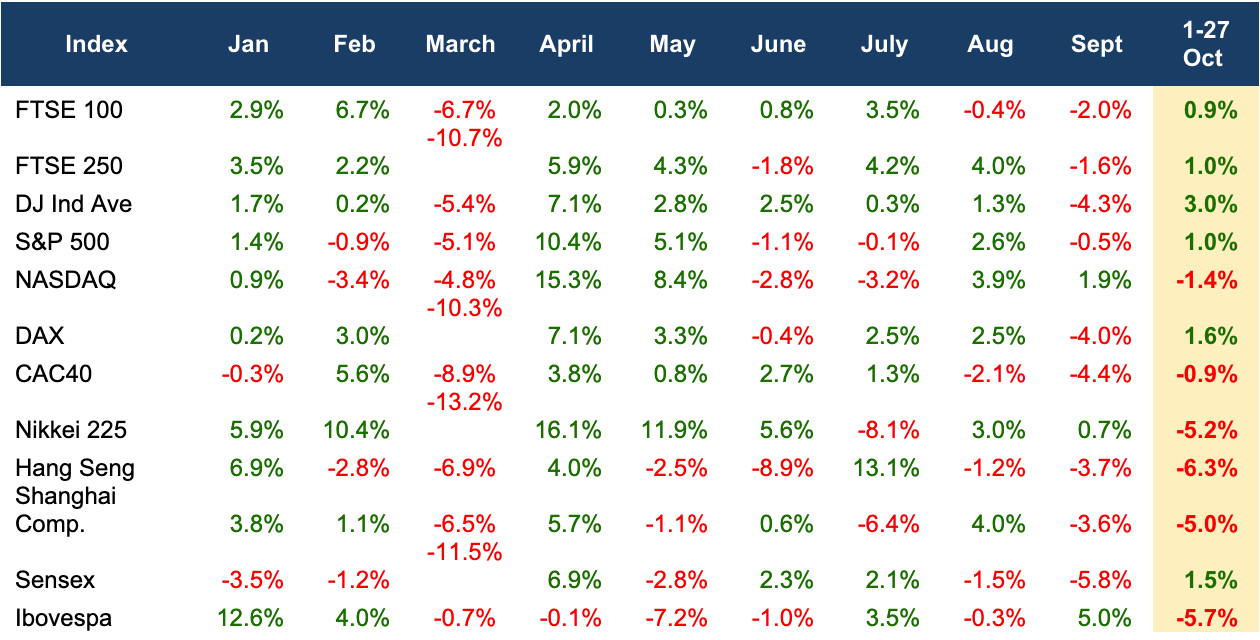
The problems above are of course on top of the continued problem of hostilities in the Gulf. Stock levels in the EU are low which points to inflation, which for now is not falling.
The impact of all of these is dispersion of returns. The top performers show no overall theme.
The best performers over the last 4 weeks
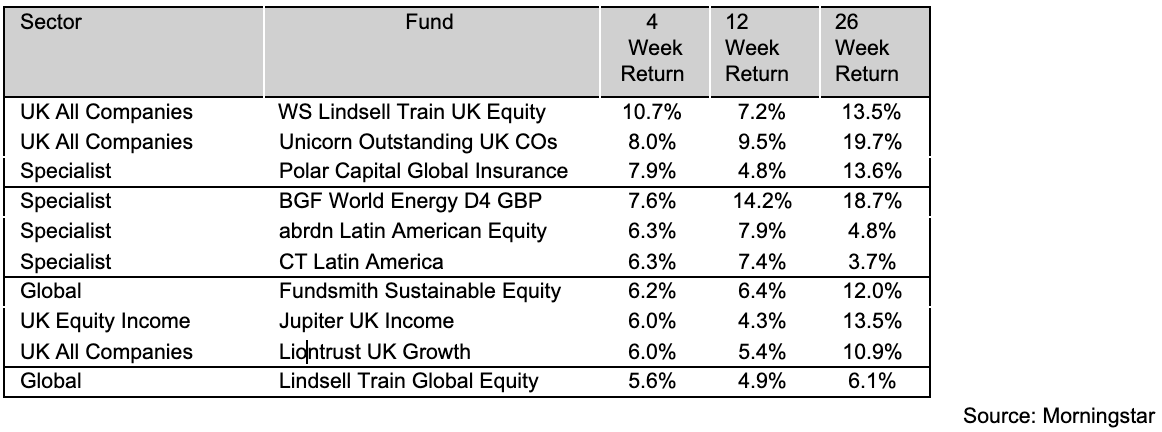
Sectors that have performed well this month? Healthcare has continued an extended rerating and defensive stocks as investors rotate away from AI.
What hasn’t done so well? Brazil – up 20% nearly and then back down following Lula’s win
Precious metals? Another loser as consolidating high interest rates and high inflation bear down on gold and silver.
Our Portfolios
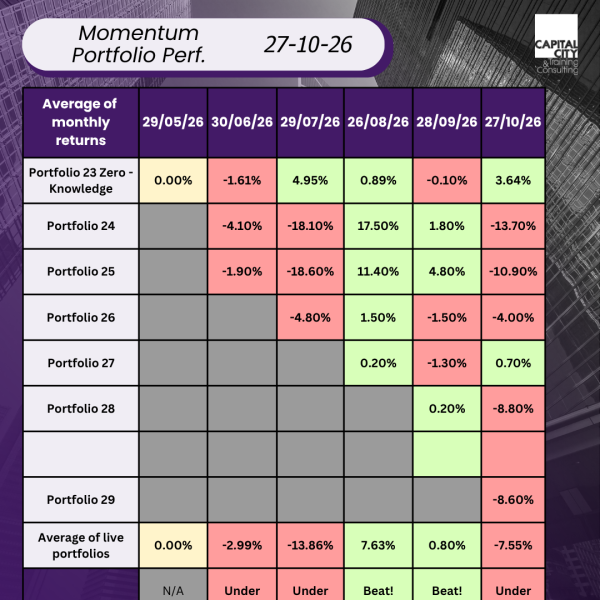
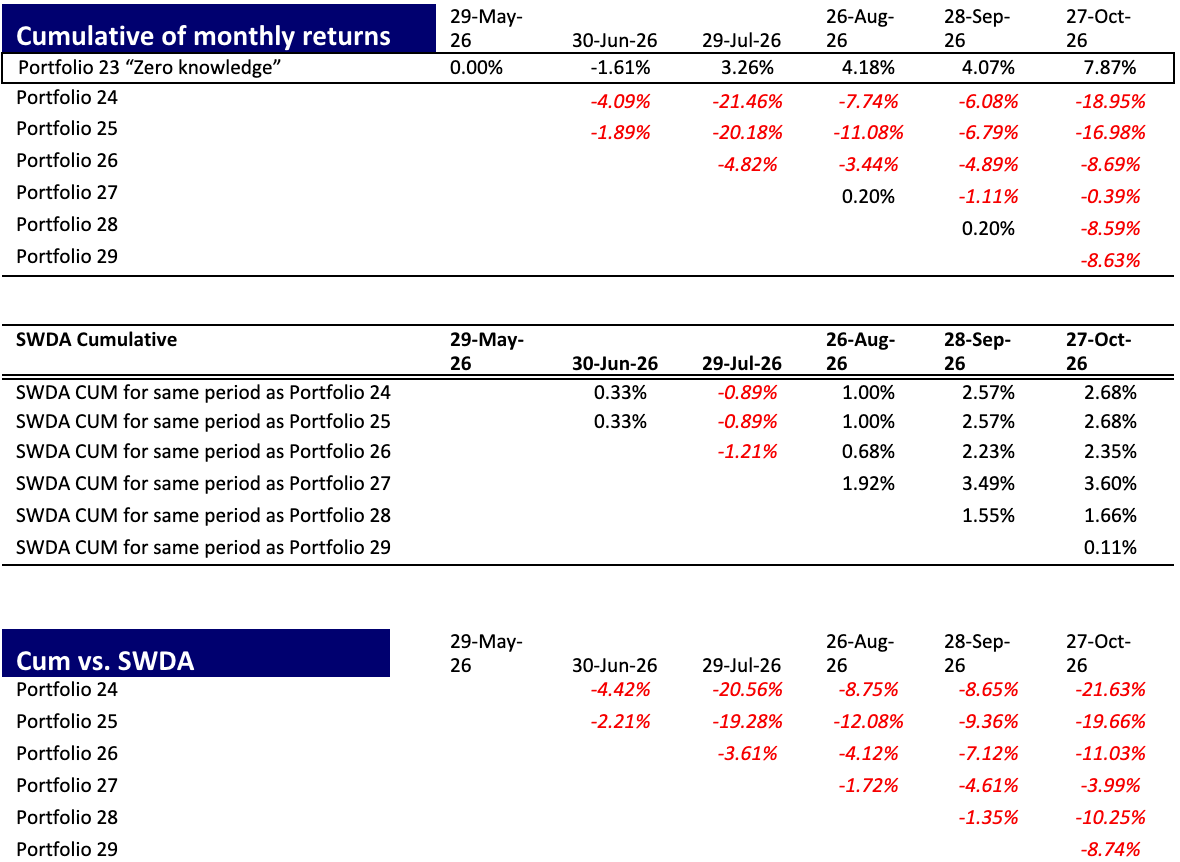
So how have the portfolios performed?
How have the individual portfolios performed?
As I warned last month, not a time to try to find momentum and indeed we haven’t. Only portfolio 27 which has exposures to non-AI adjacent stocks – insurance and UK mid-caps had a positive return. All of the other funds have suffered from catching the volatility (and ending?) of the AI uptrend.
The Zero-knowledge portfolio worked!
Interestingly the “Zero knowledge” portfolio, having started off with a wobble, has done what it was designed to do. The performance neglects a near 5% yield that TFIF would have produced over the period, increasing the return by nearly 1%. It’s beaten SWDA by 5% over 6 months!
It’s worth reminding ourselves of what the idea of the Zero Knowledge portfolio was: here’s what I wrote in March when I made it:
Given market momentum over the last month, perhaps the appropriate portfolio is a short portfolio? It is an idea worth considering and we should think about the two extreme scenarios, one will let February’s momentum reassert itself, the other will lead to a potential bear market.
The question is “does it make sense to take the risk of taking on an equity position today, when we can earn 4% plus in Government bonds or higher if we take risk on in areas like floating rate mortgage-backed securities?”
Another way to ask this question is “if we are completely ignorant about the outcome of the war, what mix of assets will do us the least harm? What zero knowledge portfolio makes sense?”
With that in mind I chose:
- Oil and gas.
- Inflation, i.e. broad commodities, one thing we do know is inflation will be higher.
- Mortgage-backed securities (subordinated) high return and although we may see poor price performance short run, we can earn high yields (c. 10% dividend yields).
- Insurance -returns are not correlated with the broader market or cyclical (in the classical sense).
A benefit I didn’t mention at the time is that the mortgage-backed CLO is floating rate.
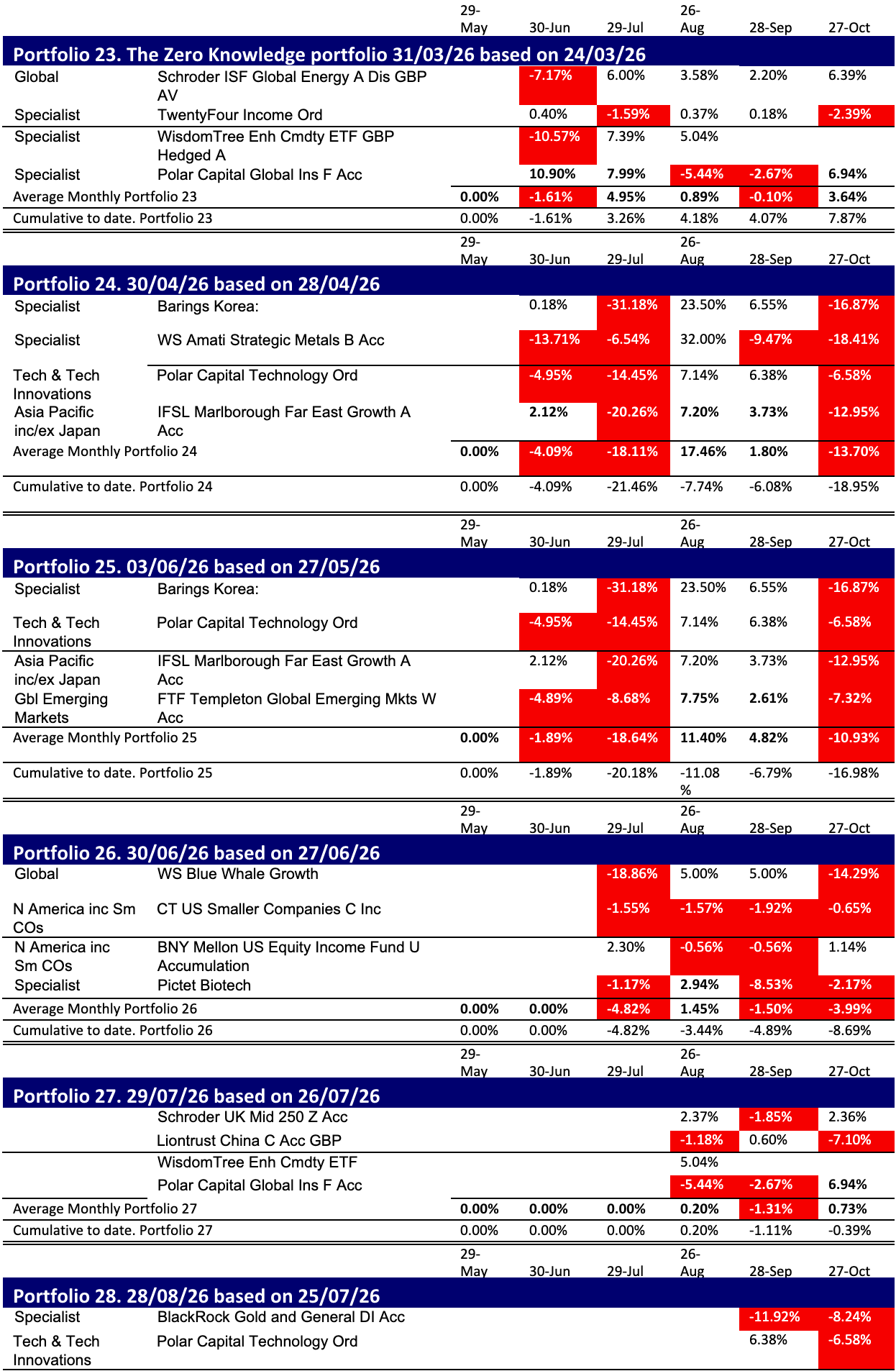
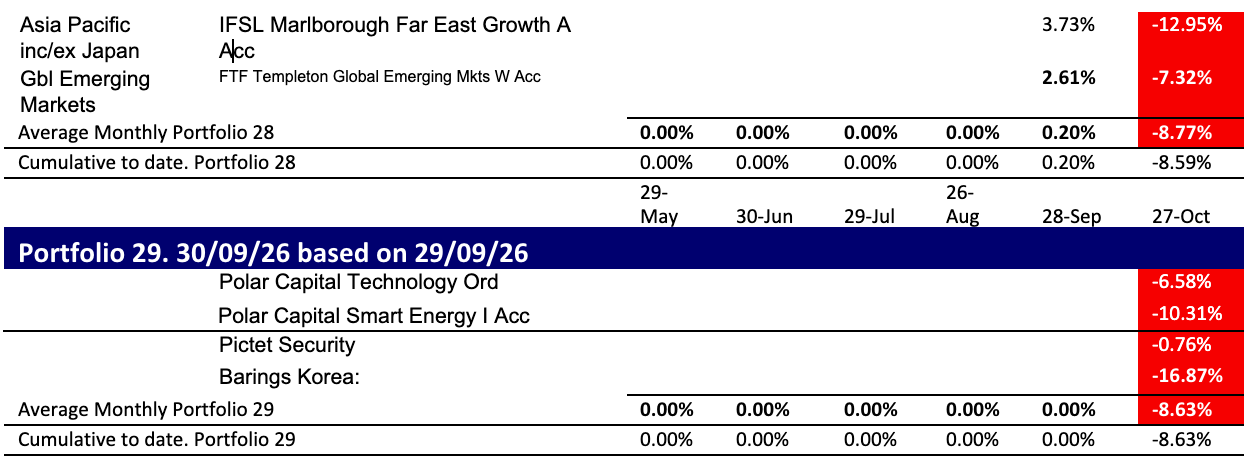
The strategy has underperformed the SWDA again, that’s six out of six months. Even portfolio 24 containing Korea (high chip) exposure, polar capital and gold which was spared last month has gone bad this month as tech and precious metals have suffered.
Once again (and again!), perhaps what we have done is to show that in the longer run, rather than a high-risk strategy like momentum, were we normal investors, we would be better served by leaving a substantial piece of our portfolios in SWDA! Winning the Losers game (to quote the author Charles D. Ellis)!
How has SWDA had such a good run? It does have a big exposure to the Mag7, but whilst their performance has diverged, they are up in aggregate over the period. a lot of the indices in the momentum portfolios have focused bets on the same two EM markets – Korea and Taiwan and the same chip companies – SK Hynix, TSMC etc.
It is interesting to think about the next six months: if AI concerns become broader, then perhaps SWDA will finally start to underperform as even the Mag7 suffer. Maybe.
Momentum in October and a new portfolio Thirty
If we look at the momentum over the last four and 26 weeks, then the ranking would be:
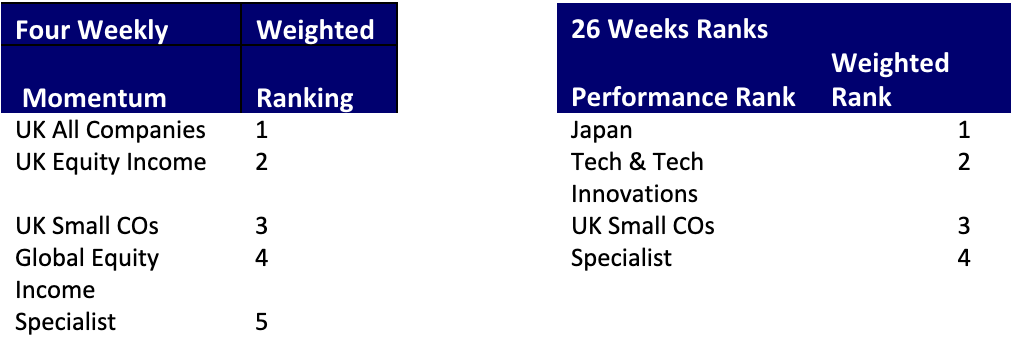
So, the four-week momentum would lead us away from tech.
I will choose a portfolio but at the same time I will reinstate the zero-knowledge portfolio to run alongside. My feeling is that the next six months will be as difficult, if not more so for markets. My guess is that the Zero-knowledge portfolio will win.
This month’s Positive momentum portfolios

Which looks very much like the Zero-knowledge portfolio. A portfolio for difficult times!
Zero knowledge portfolio

find us on substack & Youtube
access the data for yourself


Former banker turned entrepreneur. I successfully restructured, purchased, managed and sold a private engineering group, Steel Line Ltd, through an LBO and was also an equity partner in Corporate Training Group which my partners and I successfully sold to the AIM listed ILX group in 2006. I established Capital City Training Limited in early 2010 with my business partner Greg. We acquired MS Consultants a few years ago (so I’m still doing a bit of M&A). I have had non-exec roles for a small and growing VA/recruitment business and a fast-growing beverage logistics company. I am also an active investor.
Capital City Training is a full service technical and management development training company focused on the banking, wealth management and broader financial services and accounting industries. Having said all that, in the last couple of years we’ve been branching out into training for non-financial companies – manufacturing, retail, tech, defense.. so old and new economy. We also provide consultancy around modelling and are currently working for a leading PPP/PFI advisory firm. We have delivered training in every continent of the world in 2024… except Antarctica. Perhaps in 2025?! Watch this space.
Capital’s dedicated faculty combine extensive line experience as corporate financiers, bankers, traders, portfolio managers and equity analysts together with over 60 years of experience in learning and development as both procurers and providers of tailored in-house training, eLearning and blended learning. Our faculty also includes experienced Management development training specialists allowing us to provide HR consultancy services, management development training and also innovative integrated management development & technical training events. Capital City’s faculty embody over 100 years of line experience across the fields of accounting, corporate finance, derivatives, credit, lending, investment, equity research transaction banking and origination.